"Alongside" Ascendant
Language bloat amongst the prepositions.

The American-born University of Sussex linguist Lynne Murphy recently remarked on her blog (Separated by A Common Language): “A few months ago, an American friend of my spouse asked him to ask me: ‘Why is everyone suddenly saying alongside?’”
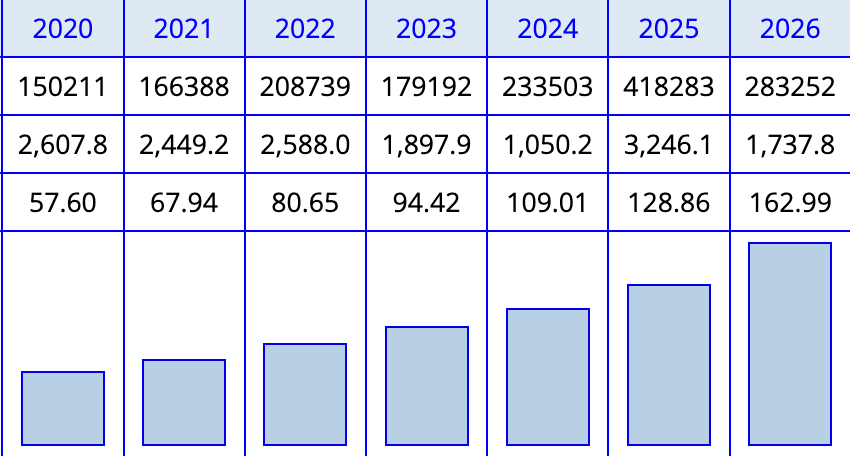
That put the word on my radar, and within days I was asking the same question as Lynne’s friend. It seemed like I couldn’t avoid “alongside”! And a little research demonstrated that the two of us weren’t imagining things. Just now, searching the word in the New York Times archive, I find that the newspaper used it fifteen times … yesterday (August 2, 2026), and a whopping 8,644 times in the previous twelve months. That’s nearly a fourfold increase from 2016, when the Times printed 2409 times “alongside”s. And an eleven-fold increase from the 769 appearances in 1996.
Those stats aren’t 100 percent reliable in showing frequency (since the newspaper prints more total words every year), but other sources show the same trend, including the News on the Web (NOW) corpus, which shows a nearly threefold increase in use of “alongside” since 2020.
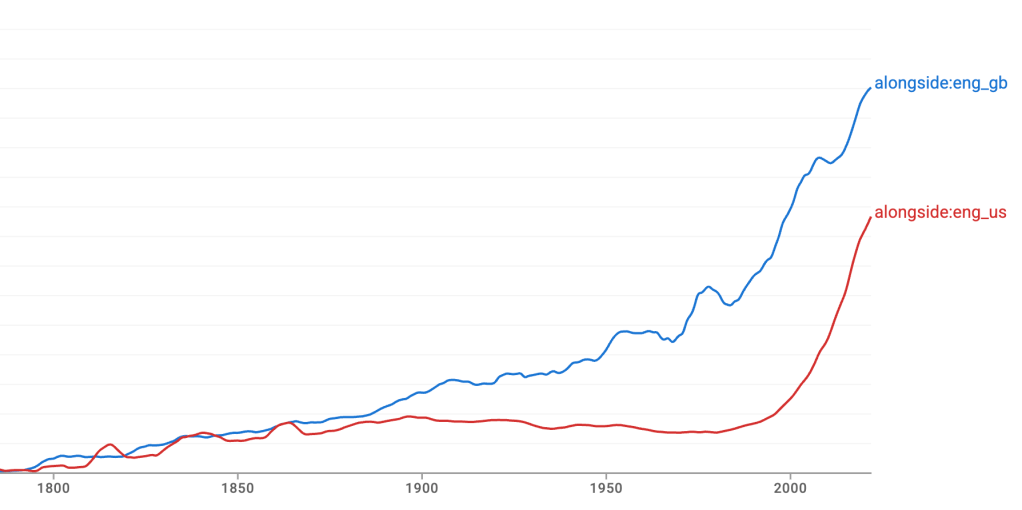
The graph shown below, from the invaluable website (for language nerds like Lynne and I, or rather Lynne and me) Google Ngram Viewer, demonstrates not only a recent “alongside” spike but also that it’s what I call a Not One-Off Britishism, or NOOB: it has been more common in Britain for more than a century, but American use has ticked up since the 1990s.
I hasten to say that “alongside” is an old word. Here’s the first definition in the Oxford English Dictionary: “Nautical. Close to the side of another vessel; side by side with another vessel. Later also: secured to a quay, wharf, etc.” This first citation is from 1704 and in 1798, there’s this from Coleridge’s poem "The Rime of the Ancient Mariner”: “The naked Hulk alongside came.” By that time the word had started being used in the non-nautical contexts we see today: first, to mean literally next to, and then more figuratively to indicate “together with” or “compared to.”
To get a sense of the current uses, here are a few examples from the New York Times, all posted today or yesterday, a couple with two in one article:
“The second-year defensive tackle has received plenty of first-team reps alongside Adam Butler and Jonah Laulu.”
“a.With Miami’s new-look roster, Adebayo is excited to pursue his first NBA title alongside Antetokounmpo…. b. The Heat’s remaining offseason priorities include adding ballhandling alongside point guard Davion Mitchell…”
“… Capt. Jessica Jackson, who worked alongside Captain Proce as an air defender…”
“a. Especially as teenagers, we figure out who we are alongside our friends: what we enjoy, what we believe in, whom we love…. b. ‘Awake Awake’ deserves a place alongside Meg Wolitzer’s ‘The Interestings’ and Claire Messud’s ‘The Burning Girl’…”
“Jenna Weakland, who engaged with the online community and appeared alongside [Nicole] LePera in videos and on podcast episodes …”
“Her book [“The Story of Your Life”] contextualizes our new memes and online community enactments alongside old rituals like the shivaree, when newlyweds were dragged from their beds by neighbors, and the wassail, a.k.a. singing to trees in the winter…”
What words or expressions would have been used if “alongside” hadn’t been so in the air? “With” (2a, 3, 5); “in addition to” (2b); “next to” (1, 4b); “together with” (4a). None of these is especially objectionable, but reading them in succession, you can’t help feeling the “alongside”s as a vogueish tic. (The sentence from 6, on the other hand, is pretty flaccid writing. Better would be something such as saying that the book under review “places our new memes and community enactments in the context of” the old rituals.)
The million-dollar question is why has the word become so voguish? Unfortunately, “why” questions are difficult to answer (well). But I will say that it fits in with a trend I’ve been following for some time: saying things with more words or even letters than used to be considered sufficient. I started noticing this fifteen years or so when the college students I taught inexplicably began to write “amongst” instead of “among” and “amidst” instead of “amid”; some even favored “whilst.” They and lots of others started adding a “t” sound in the middle of the word “often,” and sometimes replaced it with “oftentimes.” And they universally preferred “based off of” to “based on.”
There are lots of other examples in the wider culture. There used to be Communication or Admission departments; now they’re “Communications” and “Admissions.” In the last couple of years an “Advance Readers Copy” (or a pre-publication version of a book) has morphed into “Advanced Readers Copy.” (I guess it’s for advanced readers). It seems you can’t walk into a shop without getting a hearty “Welcome in!” In the light of this history, it would have been surprising if “alongside” hadn’t caught on.
The ascendance of “alongside” fits in with a trend I’ve been following for some time: saying things with more words or even letters than used to be considered sufficient.
One more point. You’ll notice that the first two Times examples I' gave are from sports coverage, which is very much given to the wordiness mentioned above. “Fans” have become “fan base,” and basketball alone has seen “three-pointer”<“made three pointer,” “drive”<“dribble drive,” “he can shoot”<“he can shoot the ball,” and “the paint”<“the painted area.”
And beyond that, I believe that athletic “alongside” has a very particular history. It starts with a late ’90s Aaron Sorkin sitcom called Sports Night, which centered on a double-anchored, smart sports news show on the model of ESPN’s Sports Center. Anyway, when one of the anchors intro’d the show, he always said “alongside”—i.e., “This is Dan Rydell alongside Casey McCall.” As Dan said it, it had a slightly ironic feel, similar to the way David Letterman would refer to "a “comedy television program.” The intro was so much a feature of the show that it’s quoted verbatim in this AV club piece.

A few years later, NFL announcer Joe Buck, started opening his coverage a particular way: “This is Joe Buck, alongside the Hall of Famer Troy Aikman.” Again, just a touch ironic, especially as it became ritualized: Buck used the same language for baseball broadcasts, subbing in John Smoltz’s name; on WNBA coverage, it’s “Ryan Ruocco, alongside the Hall of Famer Rebecca Lobo”'; and in boxing, it’s “Bernardo Osuna alongside the Hall of Famer Timothy Bradley.” The line has even filtered down to local TV—see for yourself!
Thank you for acknowledging my pain. “Welcome in” has been irksome for some time. Up there with “I know, right?”. Now I’ll have to listen for “alongside.”